How we tested Sundown: blue light and screen flicker
Sundown does two things to your Mac’s screen at night: it takes out the blue light your body clock responds to, and it keeps the backlight steady so the screen does not flicker. We had both measured. Dr. Alexander Wunsch tested the blue, and I put the screen on an oscilloscope to test the flicker. This page explains what was measured, how, and why it matters when you use your Mac at night.

By Jack RichardsFounder, Sundown · Last reviewed
Key findings
- Dr. Alexander Wunsch measured the light from a Mac screen across the whole blue band, 380 to 500 nm, with Sundown off and at deep warmth. At deep warmth, Sundown eliminates blue light.
- That band takes in the light the body clock is most sensitive to: the most potent band for suppressing melatonin was 446 to 477 nm (Brainard et al., 2001), and the clock sensor’s own peak sits near 480 nm (Zaidi et al., 2007).
- Sundown’s flicker-free mode holds the built-in display’s backlight at full power and does the dimming in software. On the oscilloscope, Sundown removes screen flicker.
- The retina responds electrically to flicker too fast to see (Berman et al., 1991), which is why we checked the backlight with an instrument rather than by eye.
Why we tested Sundown
A screen is a light source at eye level, and most of us sit in front of one for hours after dark. When researchers measured a tablet, an e-reader and a phone, all three gave off light with a strong peak in the blue (Gringras et al., 2015), the part of the spectrum the eye’s clock sensor responds to most. The science behind that sensor is on the page about the eye’s clock sensor. Sundown exists to change what your Mac sends to it, so the obvious question was whether it does, and the honest way to answer it was to measure the light rather than describe the settings.
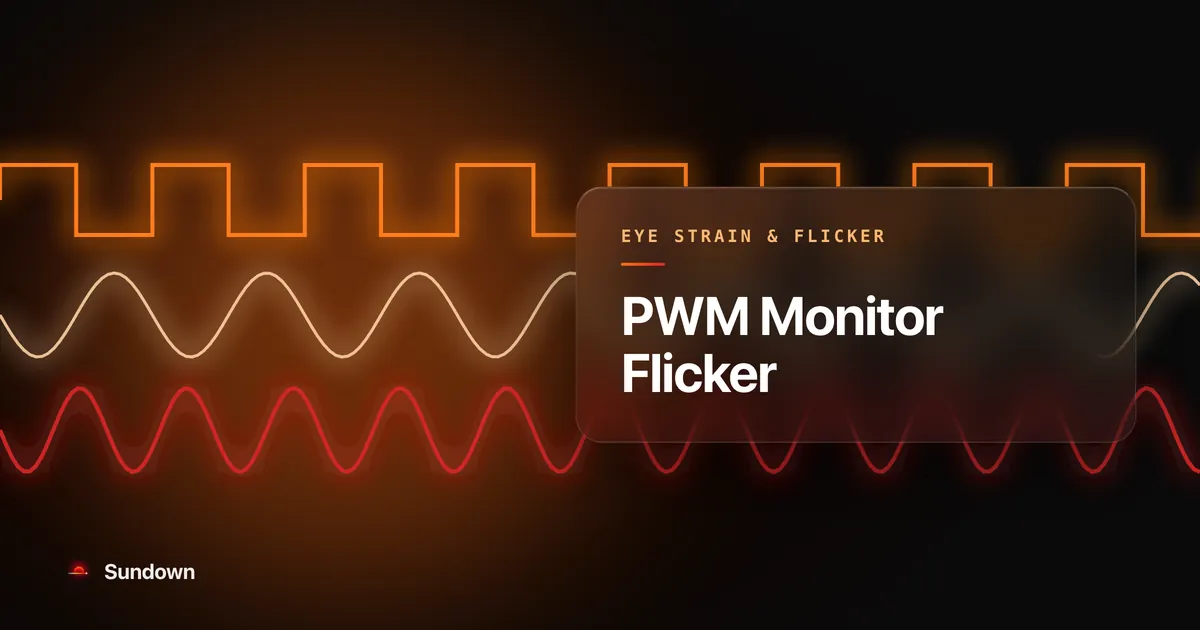
The second question was flicker. Many displays dim by switching the backlight on and off very fast, a method called pulse-width modulation, or PWM. Sundown has a flicker-free mode that is meant to take that switching out of the picture, and a claim like that is easy to make and easy to check, so we checked it.
The blue light test
Dr. Alexander Wunsch is a German physician who works on light and health, including the spectral quality of artificial light and flicker. He measured the light coming off a Mac screen with Sundown switched off and again with Sundown at deep warmth, and compared the two across the blue band, from 380 to 500 nm. Instead of picking out one wavelength, the measurement adds up all of the light across that band, so it answers the question that matters: how much blue light is the screen still sending to your eyes?
With Sundown off, the screen gave out the blue you would expect from an ordinary display. At deep warmth, the blue was gone. That is the result in plain words: at deep warmth, Sundown eliminates blue light.
What deep warmth means on your Mac
Sundown sets warmth on a colour scale, the same scale photographers and lighting designers use for the colour of light. Ordinary daylight white on a screen sits at the cool end. Night Shift stops at about the point where the screen looks a warm white. Sundown goes all the way down to its warmest, a deep red-orange, and the further down that scale you go, the less of the screen’s light falls in the blue band. Deep warmth is the warm end of that range, which is where the test found the blue gone.
Sundown also dims the screen, and that matters because the body clock responds to the total amount of light as well as its colour. A group of circadian researchers recommends keeping the light reaching your eyes to no more than 10 lux melanopic EDI, a unit weighted for the clock sensor, from at least three hours before bed (Brown et al., 2022). Taking the blue out and turning the light down together is how a screen gets anywhere near that, and it is why Sundown does both. The page on brightness, colour and melanopic lux goes into the measure itself.
The flicker test
Pulse-width modulation dims a backlight by switching it on and off many times a second and varying how long it stays on. The switching is far too fast to see as flicker, but it is still there, and the eye is not blind to it. In one study, the retina produced a measurable electrical response in step with flicker faster than people can see, from a computer monitor and from fluorescent lighting (Berman et al., 1991). In offices, when fluorescent tubes were switched to electronic ballasts that cut their flicker from a modulation of 43 to 49% to below 7%, reported headaches and eyestrain more than halved (Wilkins et al., 1989). That was lighting, not a laptop, but it is the reason flicker is worth taking seriously.
Sundown’s flicker-free mode deals with it by not asking the backlight to dim at all. It holds the built-in display’s backlight at full power and does the dimming in software, through the display’s colour tables, so the screen gets darker while the backlight stays steady. I tested the screen with a USB oscilloscope, with flicker-free mode on. No flicker. Sundown removes screen flicker.
If you want the background, the post on flicker-free mode explains the setting, and the page on PWM and invisible flicker covers the research.
What it means when you use Sundown
In practice it comes down to two settings. In the evening, take the warmth deep, because that is where the blue is gone, and let Sundown dim the screen as well, because less light overall means less signal to your body clock. Keep flicker-free mode on, and the backlight stays steady however dark you take the screen.
None of that asks you to stop using your Mac at night, which for most people was never going to happen anyway. It changes the light the Mac gives you while you use it.
Questions people ask
- Does Sundown block blue light?
- Yes. Dr. Alexander Wunsch measured a Mac screen across the blue band, 380 to 500 nm, with Sundown off and at deep warmth. At deep warmth, Sundown eliminates blue light.
- Does Sundown remove screen flicker?
- Yes. Flicker-free mode holds the built-in display’s backlight at full power and dims in software, and on an oscilloscope the screen showed no flicker.
- Why measure 380 to 500 nm?
- Because that band holds the light the body clock responds to most: the most potent band for suppressing melatonin was 446 to 477 nm (Brainard et al., 2001), and the clock sensor’s peak is near 480 nm (Zaidi et al., 2007).
- Is a warm screen enough on its own?
- Warmth takes out the blue, and dimming lowers the total light, and the body clock responds to both. A consensus of circadian researchers recommends no more than 10 lux melanopic EDI at the eye from three hours before bed (Brown et al., 2022), which is why Sundown warms and dims.
Put the research to work on your Mac
Sundown warms your Mac’s display down to a deep red and dims it after dark. Tested by Dr. Alexander Wunsch, it eliminates blue light. Its flicker-free mode removes screen flicker too.
The research
Every study cited above, with its design, its sample size and what it found, linked to the paper. Each record was read on PubMed or the journal’s site.
- 01
Brainard GC, Hanifin JP, Greeson JM, et al. (2001). Action spectrum for melatonin regulation in humans: evidence for a novel circadian photoreceptor. The Journal of Neuroscience.
Lab study · n: 72 adults, 627 tests
Found: Mapped which colours of light suppress melatonin at night. The most potent band was 446 to 477 nm, which is blue.
Limits: Single-colour light at 2 to 3:30 in the morning with dilated pupils, not a screen.
PubMed 11487664 ↗DOI 10.1523/JNEUROSCI.21-16-06405.2001 - 02
Zaidi FH, Hull JT, Peirson SN, et al. (2007). Short-wavelength light sensitivity of circadian, pupillary, and visual awareness in humans lacking an outer retina. Current Biology.
Case reports · n: 2 blind patients
Found: Two people with no working rods or cones: in the man, short-wavelength light suppressed melatonin, reset the clock and raised alertness more than 555 nm light; in the woman, pupil sensitivity peaked at 480 nm and she could report a faint 480 nm flash but no other wavelength.
Limits: Two people.
PubMed 18082405 ↗DOI 10.1016/j.cub.2007.11.034 - 03
Berman SM, Greenhouse DS, Bailey IL, Clear RD, Raasch TW (1991). Human electroretinogram responses to video displays, fluorescent lighting, and other high frequency sources. Optometry and Vision Science.
Lab study · n: Not stated in abstract
Found: The retina produced a measurable electrical response in step with flicker faster than people can see: up to 76 Hz from a monitor and 145 Hz from a fluorescent light.
Limits: A response in the retina is not the same as a symptom. Old CRT monitors.
PubMed 1923343 ↗DOI 10.1097/00006324-199108000-00012 - 04
Gringras P, Middleton B, Skene DJ, Revell VL (2015). Bigger, Brighter, Bluer-Better? Current Light-Emitting Devices: Adverse Sleep Properties and Preventative Strategies. Frontiers in Public Health.
Measurement study · n: 3 devices
Found: A tablet, an e-reader and a phone all gave off light with a strong blue peak. The authors call for a bedtime mode that shifts the screen to yellow and red and also lowers its brightness.
Limits: Measured the devices, not anyone's sleep.
PubMed 26528465 ↗DOI 10.3389/fpubh.2015.00233 - 05
Brown TM, Brainard GC, Cajochen C, et al. (2022). Recommendations for daytime, evening, and nighttime indoor light exposure to best support physiology, sleep, and wakefulness in healthy adults. PLOS Biology.
Expert consensus · n: Consensus of researchers
Found: Recommends no more than 10 lux melanopic EDI at the eye from at least 3 hours before bed, and under 1 lux while you sleep.
Limits: A recommendation built from the evidence, not a new experiment. Written for healthy adults.
PubMed 35298459 ↗DOI 10.1371/journal.pbio.3001571 - 06
Wilkins AJ, Nimmo-Smith I, Slater AI, Bedocs L (1989). Fluorescent lighting, headaches and eyestrain. Lighting Research & Technology.
Double-blind crossover (offices) · n: Office workers; not stated in abstract
Found: When office fluorescent tubes were switched to electronic ballasts that cut their 100 Hz flicker from a modulation of 43 to 49% to below 7%, the average rate of headaches and eyestrain more than halved.
Limits: Fluorescent tubes in 1989, not screens. Not indexed on PubMed; the link goes to the journal record.
DOI 10.1177/096032718902100102 ↗
How to cite this page
Richards, J. (2026). How we tested Sundown: blue light and screen flicker. Sundown. https://trysundown.com/science/how-we-tested-sundown (last reviewed 11 October 2026).
Found a study we missed, a link that has rotted or a sentence that overstates a paper? Write to support@trysundown.com and we will correct it and update the review date.
Notes on the research
- The blue light result is for Sundown’s deep warmth settings. At lighter settings the screen keeps more of its blue, which is why we suggest going deep in the evening.
- We state the result in words rather than as a percentage. Sundown sets warmth on a colour temperature scale, and the measurement chart, with the warmth settings it was taken at, will be added to this page.
- Flicker-free mode works on the Mac’s built-in display. An external monitor’s backlight is run by the monitor itself.
- Dr. Wunsch is Chief Scientific Advisor to an eyewear company whose founder is a Sundown partner.
- The studies on this page explain why the blue band and flicker matter to your body (Brainard et al., 2001; Zaidi et al., 2007; Berman et al., 1991; Wilkins et al., 1989). The Sundown results are the two tests described above. The office lighting result is for fluorescent tubes in 1989 (Wilkins et al., 1989), and the device measurements are of a tablet, an e-reader and a phone (Gringras et al., 2015).
- Sundown is a display utility, not a medical device. It does not diagnose or treat any condition.