f.lux for Mac: How to Download It, and What Happened to It

By Jack RichardsFounder, Sundown
You came here to download f.lux for your Mac, so here is the link: justgetflux.com. It is free, it still installs, and on most Macs it will still warm your screen tonight.
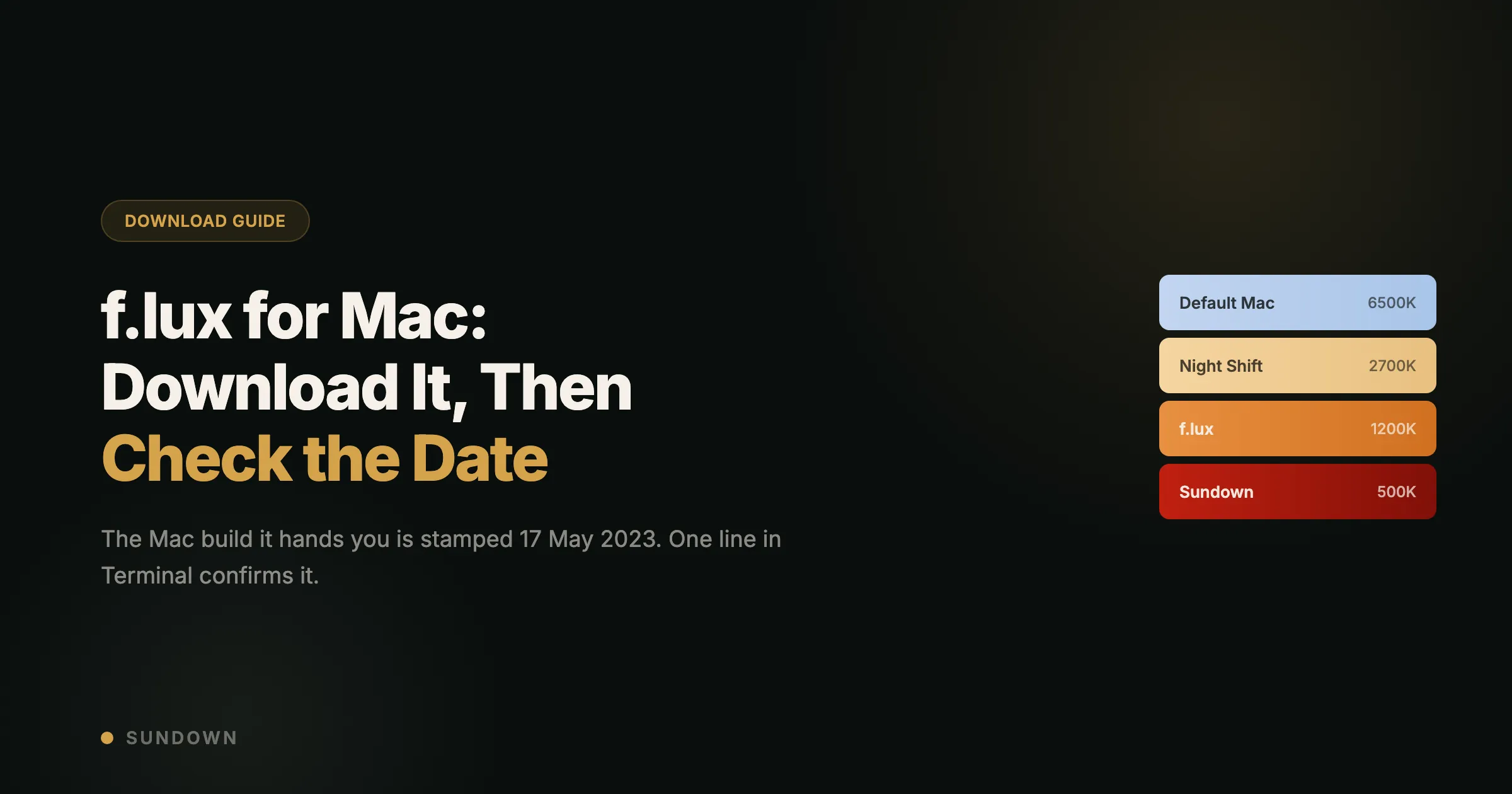
What isn't printed above the download button is that the Mac build waiting on the other side of that link is dated 17 May 2023. That 2023 is the date on the file itself, which you can confirm yourself in one line, and this post will show you how.
Where to Download f.lux for Mac
Download f.lux for Mac from justgetflux.com, the developer's own site. The Mac download is a ZIP archive of roughly 2.1 MB containing version 42.2, and it is free, with no account and no trial timer.
The direct file link is justgetflux.com/mac/Flux.zip, which redirects to f.lux's CDN at macflux.b-cdn.net, and that redirect will matter in a moment.
Get it from the official site and skip the download portals. Software mirrors often list their own upload date as the release date, and some serve an older build than the vendor does, so a listing that looks freshly updated may be neither current nor the file f.lux would give you. When the original is free and one click away, a mirror adds risk and gives you nothing back.
Is f.lux Still Being Updated for Mac?
The Mac build isn't, but the company is. Those are two different questions.
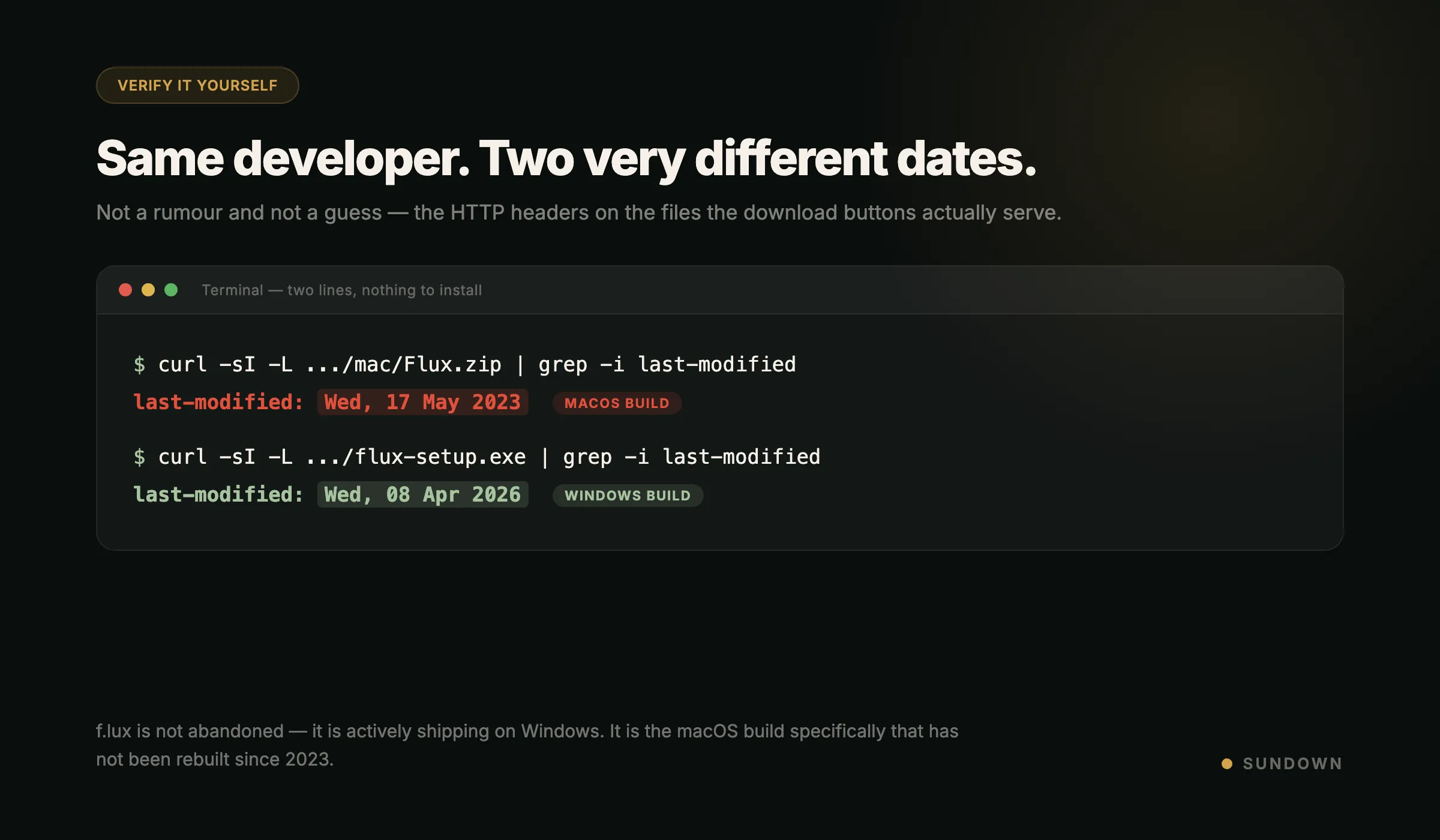
The macOS binary f.lux ships today carries a last-modified date of 17 May 2023. Its version is 42.2, and f.lux's own update feed at justgetflux.com/mac/macflux.xml contains exactly one entry, dated 1 June 2023, which makes that single entry the complete Mac release history the app advertises to itself.
The Windows installer tells a completely different story, because it is dated 8 April 2026.
curl -sI -L https://justgetflux.com/mac/Flux.zip   | grep -i last-modified
curl -sI -L https://justgetflux.com/flux-setup.exe | grep -i last-modified
Those two lines print two dates, Wed, 17 May 2023 and Wed, 08 Apr 2026. We measured both, following the redirects to the files actually served.
So the developer never went anywhere: f.lux is an actively maintained Windows application whose macOS build stopped three years ago. Anyone telling you f.lux has stopped is wrong, and so is anyone telling you the Mac version is current, because the truth is narrower and more specific than either.
What f.lux Got Right
It is still good software, in a real sense. f.lux goes to a deep orange, well past Night Shift's warm white floor, and it is free, with no upsell and no account. If you installed it in 2015 and never thought about it again, it served you well, and nothing here is an argument that you were wrong.
The lights are still on, too. The Windows release from April 2026 is recent work, and f.lux's macOS support forum still sees posts this year, so this isn't a story about a company that vanished.
The argument is narrower than that. The Mac in front of you is not the Mac f.lux was last built for.
How to Install f.lux on a Mac
Installation is four steps and takes about a minute:
- Download the ZIP from justgetflux.com and let Safari or your browser unzip it.
- Drag
Flux.appinto your Applications folder. Running it from Downloads works but breaks the moment you clear that folder. - Open it. On first launch macOS will ask you to confirm an app downloaded from the internet, which is normal Gatekeeper behaviour and says nothing about f.lux specifically.
- Grant location access when prompted, or type your city manually, because f.lux needs to know where you are to know when your sun sets.
To have it start automatically, add it under System Settings → General → Login Items, or use f.lux's own "start at login" checkbox. Either works.
Is f.lux Safe to Download?
Yes. It comes from the developer's own domain over HTTPS. "An old Mac build" and "unsafe software" are different claims, and only the first one is on the table here.
With a 2023 binary the real risk is fit, since safety isn't the issue. A text editor can keep working forever, but software that reaches into the display layer is more like a plug in a socket the operating system keeps rewiring. macOS has shipped several major versions since the date on that build, each with its own changes to how displays, colour profiles, and permissions are handled, and an app that hasn't been rebuilt against any of them is running on inertia.
f.lux vs Night Shift vs Sundown: How Deep Each One Goes
Colour temperature is the one specification you can compare directly, because it is measured on a standard scale. Lower is warmer, and lower is what your body reads as "evening."
| Night Shift | f.lux | Sundown | |
|---|---|---|---|
| Warmest setting | A warm white | A deep orange | A deep red |
| PWM flicker-free mode | No | No | Yes (built-in display) |
| Latest Mac release | Ships with macOS | 17 May 2023 | Actively maintained |
| Price | Free | Free | $4.99/mo, $39/yr, or $79 lifetime |
f.lux's date in the third row comes from the HTTP header above, so it is a public artifact, and Sundown's release history is public too, in our update feed at trysundown.com/appcast.xml. You don't have to trust a marketing page for either one.
The gap between f.lux's warmest and Sundown's warmest is the part worth understanding. f.lux stops at a deep orange, while Sundown goes down to a deep red, and at that setting the blue channel is turned off.
What the Science Actually Supports
Ostrin et al. (2017) found blue-blocking lenses raised nocturnal melatonin ~58% in healthy adults, who also slept ~24 minutes longer. That study, by Ostrin, Abbott and Queener and published in Ophthalmic & Physiological Optics (PMID 28656675), is about lenses worn over the eyes, not about display colour temperature.
The counterweight belongs in the same paragraph. A 2023 Cochrane review by Singh, Keller, Busija and McMillan (PMID 37593770) examined blue-light-filtering spectacle lenses and found they may not reduce eye strain from computer use, and that their effect on sleep was indeterminate. Anyone selling you a screen filter should be willing to tell you that paper exists.
Our full citation list, including the Cochrane review, lives on the Sundown science page. We put the paper that argues against us on our own site on purpose.
If f.lux Won't Launch: What to Try First
Things that are worth trying, in order:
- Check for a conflicting filter. Night Shift and f.lux changing the display colour at once give unpredictable results, so turn Night Shift off in System Settings → Displays → Night Shift.
- Re-grant location access. It lives in System Settings → Privacy & Security → Location Services, and if f.lux does not know where you are, it does not know when to start.
- Quit and relaunch after connecting an external display.
- Restart.
The thing people try first is reinstalling, and it doesn't help. Downloading the ZIP again gets you a byte-identical copy of the same 2023 binary, and since there is no newer Mac build waiting behind a fresh download, a reinstall changes nothing about compatibility, so you can save yourself the round trip.
Should You Still Use f.lux in 2026?
If you want a free warmth filter, you're happy at its deep orange and it works on your machine, then yes, keep it. It costs nothing and it does the job, and we are not going to pretend that a working free app is a crisis.
Reconsider if any of these are true: your MacBook's backlight dims with PWM and you want dimming that doesn't lean on it, or you want to go meaningfully warmer than f.lux's deep orange.
That last one is the whole case, and it comes down to preference. A 2023 binary is a 2023 answer to a question macOS has re-asked several times since. Our Sundown vs f.lux comparison sets out the differences side by side if you want to weigh them.
Sundown reaches a deep red, includes a PWM flicker-free dimming mode that neither f.lux nor Night Shift offers, and is actively maintained. There is a 7-day free trial at trysundown.com, so you can install both, run f.lux one evening and Sundown the next, and let your own eyes settle it. If f.lux wins, keep f.lux.
Frequently Asked Questions
Is f.lux free?
Yes. f.lux is completely free on macOS with no account, trial period, or paid tier.
What is the latest version of f.lux for Mac?
Version 42.2. f.lux's own update feed lists it with a date of 1 June 2023, and the binary itself carries a last-modified date of 17 May 2023. Download mirrors sometimes display their own upload date instead, which is why some listings look more recent than they are.
Does f.lux work on the current version of macOS?
It installs and generally runs. It has not been rebuilt for the macOS versions released since May 2023, so it has no native support for display changes introduced after that date, and compatibility is the thing to watch far more than security.
Is f.lux still being developed?
Yes. f.lux still ships: its Windows build is dated 8 April 2026. The Mac build hasn't changed since 17 May 2023.
Is f.lux better than Night Shift?
On depth, yes, because f.lux reaches a deep orange against Night Shift's warm white floor, and its scheduling is more flexible too. See our full Night Shift vs f.lux comparison.
What should I use instead of f.lux on a Mac?
It depends on what is missing for you. If it is depth or flicker, Sundown goes down to a deep red and adds flicker-free dimming. We compare the full field in our guide to f.lux alternatives for Mac.
The Short Version
Download f.lux from justgetflux.com. It is free and it still works.
Then run the two commands in this post and look at the dates: one is the Mac build you just installed, and the other is what the same developer shipped to Windows this year. Whatever you decide after that, you'll have decided it on measured facts and not on anyone's marketing, ours included.